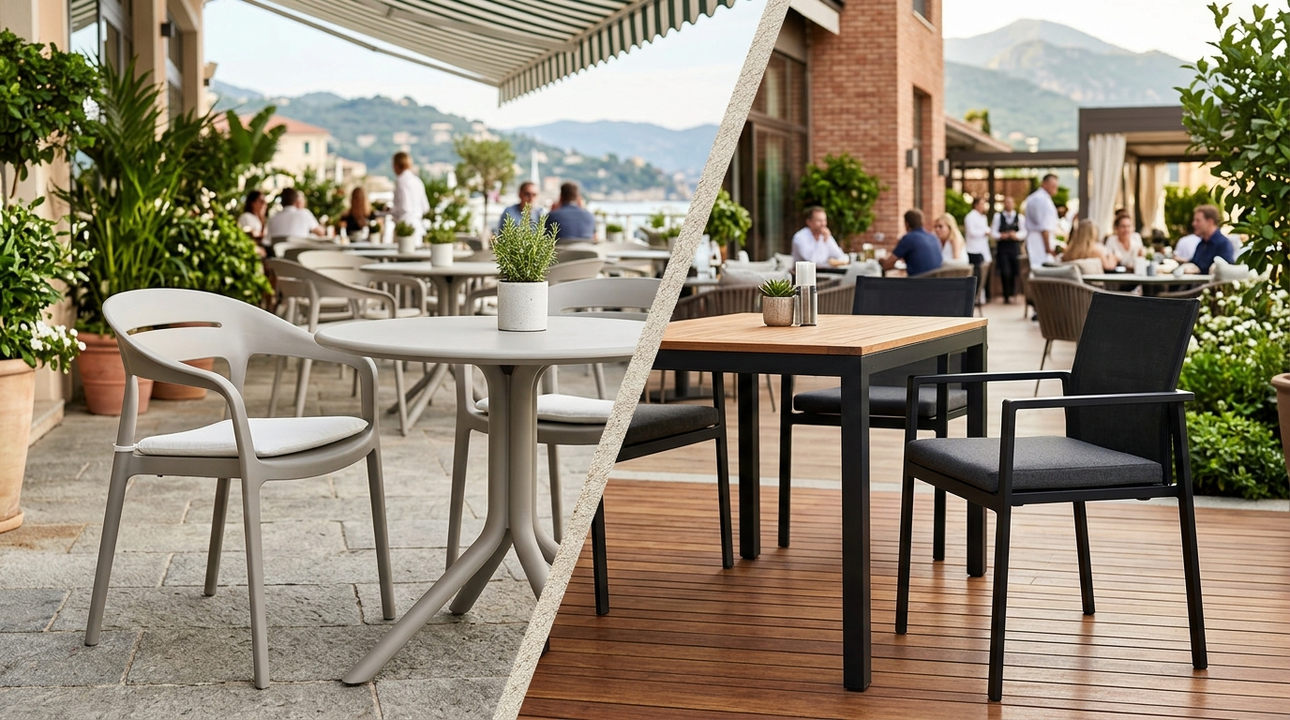
When a restaurateur or hotelier orders furniture for a terrace, the question of material comes up sooner or later. Aluminium and polypropylene are by far the most common materials for professional outdoor use today — yet they differ in properties, suitability and cost logic more than first appearances suggest.
This guide is not an advertisement for either. It is a comparison that helps you understand which material is right for your specific context.
Furniture for a hospitality terrace is not merely a visual choice. It is a logistical, maintenance and financial decision you will live with for the next 8 to 15 years. A material that is ideal for a hotel pool terrace in a Mediterranean climate is not necessarily optimal for a restaurant with mixed indoor and outdoor use in a continental climate.
Both materials — aluminium and polypropylene — are represented today among certified professional furniture for the HoReCa sector. Furniture for public use must, under standard EN 581-2 (Class 2 / Contract), pass considerably stricter tests than its domestic equivalent: the static seat load for the professional class is 150 kg without permanent deformation, compared to only 90 kg for the domestic class. This difference in requirements is reflected both in structural dimensioning and in material selection — and it applies to both materials discussed here.
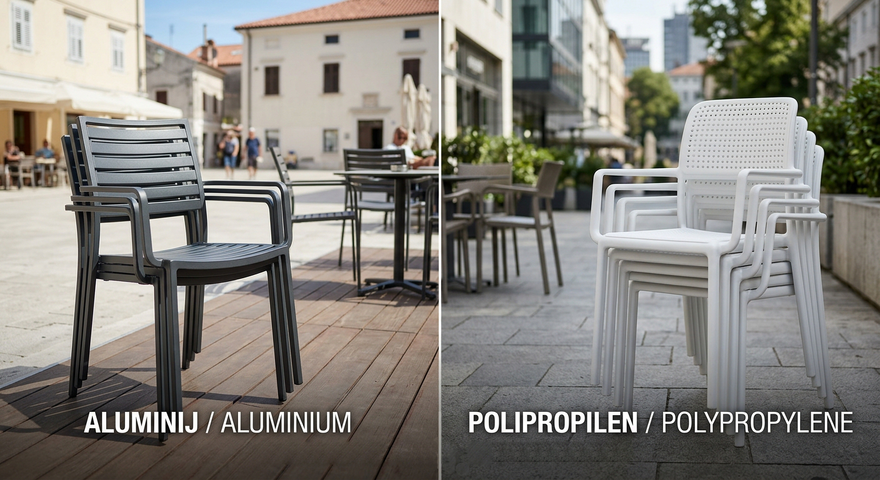
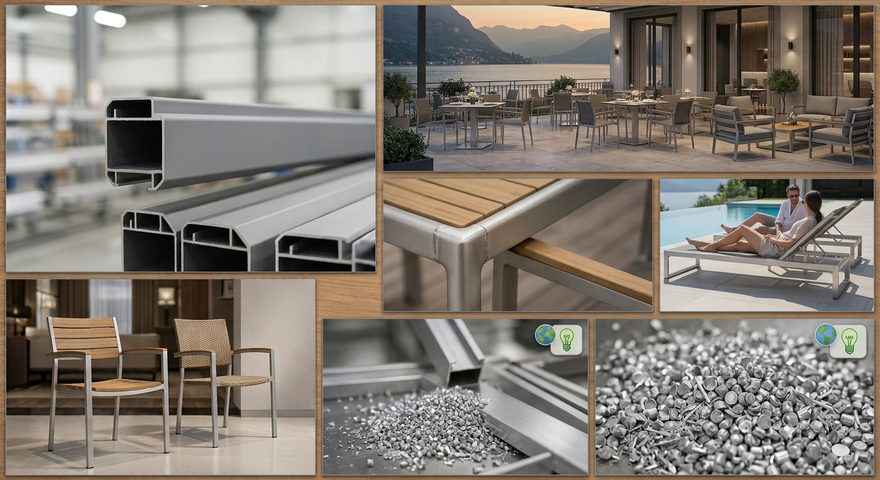
Professional outdoor aluminium furniture is most commonly made from powder-coated aluminium profile with a wall thickness of 2.0–2.5 mm or more. Thinner profiles (1.0–1.5 mm) appear in cheaper furniture for domestic use — they are not suitable for professional HoReCa applications.
Aluminium is:
You will find aluminium chair and table models for professional use in our range of garden chairs and garden table bases and tables. Two typical examples of aluminium construction in our range are the Victory ZRN, with an aluminium frame and a techno-rattan seat with double UV protection, and the Teak Alu ZRN, which combines an aluminium frame with a teak wood seat — both certified to SIST EN 581-1 and 581-2.
It heats up. Aluminium conducts heat better than plastic — furniture in direct sunlight becomes hot to the touch, which is unpleasant for guests at the pool. The solutions are shading, textile seats (Batyline, Textilene) or furniture with mesh seats, which reduce skin contact with the surface. On sun loungers for pool terraces, the combination of an aluminium frame and a textile sling is the industry standard for precisely this reason.
Higher purchase price. A professional aluminium chair is on average more expensive than an equivalent polypropylene model. The difference depends on the model and supplier, but it is noticeable when comparing equivalent classes.
Coating durability: Research published in the journal Metals (MDPI), comparing the corrosion resistance of powder-coated 6060 aluminium alloy, showed that a properly applied coating provides high barrier protection — but only as long as it remains undamaged. Mechanical damage (scratches, impacts) is the point where moisture begins to penetrate beneath the coating. Coating systems that include pre-anodising demonstrated significantly better resistance under prolonged exposure to moisture and salt. Reputable suppliers offer coating touch-ups as part of their maintenance programme.
Powder coating is not used on aluminium alone — an example of a quality powder-coated metal construction for professional outdoor use is the Philia Mesh by the Italian manufacturer Pedrali, where the tubular steel frame is protected with a powder coating designed for outdoor conditions.
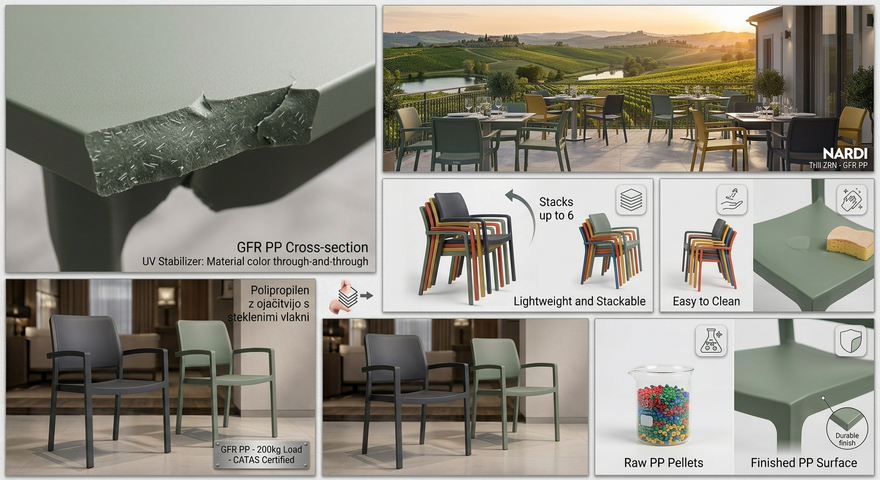
Polypropylene (PP) is a thermoplastic that appears in professional furniture in two versions: pure polypropylene and glass-fibre-reinforced polypropylene (GFR PP). For professional HoReCa use, the reinforced version is recommended — its rigidity and resistance to deformation at high temperatures are significantly better.
Quality polypropylene for outdoor use:
You will find polypropylene and other plastic models for intensive hospitality use among our garden chairs and banquet chairs. A textbook example of properly formulated GFR polypropylene is the Trill ZRN by the Italian manufacturer Nardi — glass-fibre-reinforced polypropylene with additional UV protection, a 200 kg load capacity, CATAS certified to UNI EN 581-1 and 581-2, at a weight of just 3.7 kg and stackable up to 6 pieces.
Thermal deformation. Polypropylene is a thermoplastic material — at high temperatures (55–70 °C on the furniture surface in full sun) it softens slightly. In quality reinforced PP this effect is minimal and reversible; in unreinforced or blended PP, permanent seat deformation appears after seasons of intensive use.
Embrittlement with age. UV degradation of polypropylene proceeds via photo-oxidation — UV rays break down the polymer chains, progressively reducing the material's tensile strength and elongation. A study published in Photochemical & Photobiological Sciences (Springer Nature, 2023) showed that inadequately stabilised polymers lose a large share of their mechanical properties after prolonged sun exposure — the material becomes brittle and cracks under load instead of flexing. The key difference between quality and cheaper products lies precisely in the formulation: UV stabilisers mixed into the mass work throughout the material's entire service life, while surface coatings break down within the first seasons. A separate study (ResearchGate, 2025) measured changes in the tensile strength of PP at various durations of UV exposure and confirmed that degradation in unstabilised PP is noticeable after just 500 hours — which, on a terrace with intensive sun exposure, means less than a single season. An EN 581 certificate for professional use is one indicator that the material is properly formulated; details are in our guide to certificates for HoReCa furniture.
Visual class. Polypropylene is often perceived as more functional and less prestigious than aluminium — a relevant limitation for certain hospitality concepts (high-category hotels, fine dining).
| Parameter | Aluminium | Polypropylene (GFR) |
|---|---|---|
| Corrosion resistance | Excellent | Excellent (no metal) |
| UV resistance | Excellent (coating) | Excellent (stabiliser in mass) |
| Dimensional stability in heat | Excellent | Good (in reinforced version) |
| Weight | Medium | Low |
| Purchase price | Higher | Lower |
| Service life (professional use) | 10–20 years | 7–15 years |
| Colour options | Limited (coating) | Wide (colour in mass) |
| Maintenance | Minimal | Minimal |
| Replaceable parts (seat, mesh) | Yes (modular models) | Rarely |
| Visual class | Premium | Functional |
Aluminium is the optimal solution for:
Polypropylene is the optimal solution for:
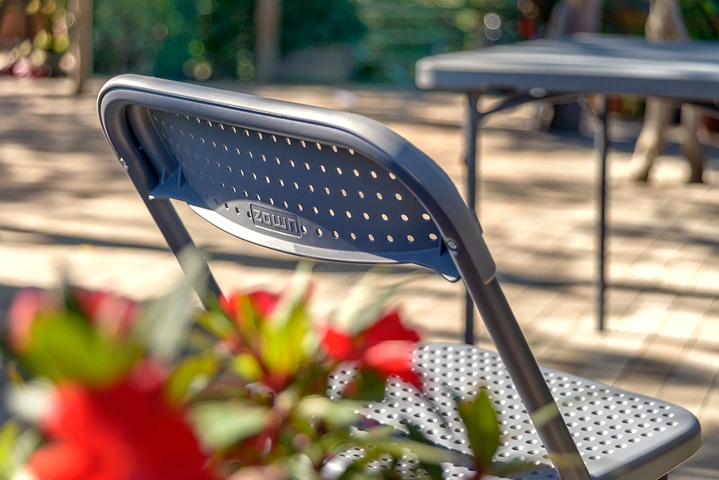
High-density polyethylene (HDPE) is the third plastic alternative, found in professional furniture in certain premium lines — among them ZOWN New Classic, where HDPE is the material of the seats and tabletops. Compared to standard polypropylene, HDPE has better dimensional stability under prolonged static load and is somewhat more resistant to high temperatures.
An experimental analysis published in npj Materials Degradation (Nature, 2025) examined how different ageing conditions — thermal ageing, moisture and UV exposure — affect the mechanical properties of HDPE. The results showed that HDPE retains a significantly higher share of its initial tensile strength and toughness compared to standard PP under the same ageing conditions, confirming its advantage in intensive outdoor use.
In practice, HDPE positions itself between standard polypropylene furniture and aluminium — higher plastic quality, lower price than aluminium, longer service life than standard PP. We have covered the ZOWN collection in more detail in our ZOWN New Classic overview.
Purchase price is the wrong criterion for comparing furniture materials in professional use. The right criterion is total cost per year of use — purchase price divided by years of use, plus maintenance.
An example for a restaurant chair:
| Aluminium (premium) | Polypropylene (professional) | |
|---|---|---|
| Purchase price (indicative) | €180 | €80 |
| Expected service life | 15 years | 10 years |
| Annual cost excluding maintenance | €12 | €8 |
| Maintenance (annual, average) | €1–2 | €0.5–1 |
| Total annual cost | ~€13–14 | ~€8.5–9 |
The difference in annual cost is smaller than the purchase price suggests. For hotels and complexes ordering 200 or more pieces, this difference totals €800–1,000 per year — relevant, but not decisive if aluminium offers a better guest experience.
Before ordering, answer three questions:
1. What is the location's exposure? Direct Mediterranean or coastal conditions, constant sun exposure and moisture — choose aluminium or HDPE. A shaded terrace in a continental climate — polypropylene is sufficient.
2. What is the visual standard of the concept? Boutique hotel, fine dining, wellness — aluminium. A restaurant focused on functionality and fast guest turnover — polypropylene.
3. How often is the furniture moved? Event use, stacking, transport between venues — polypropylene or HDPE (lighter). Fixed or semi-fixed installation — aluminium.
For larger hotel projects, it is also worth looking at our dedicated hotel equipment page, which brings together models suitable for public use.
There is no universally better material. Aluminium wins on durability, visual class and resistance to extreme conditions; polypropylene on price, weight and colour options. For most hospitality terraces, both materials — given a correctly chosen model and a certificate for professional use — are sound long-term solutions.
The mistake hospitality operators make most often is not choosing wrongly between aluminium and polypropylene furniture — it is buying domestic-class furniture for professional use. The difference between Class 1 and Class 2 under EN 581 is, at that point, more decisive than the choice between materials.
Looking for aluminium or polypropylene furniture for your terrace? Contact us — we advise on material, model and certification for your specific location and use.
Autor članka: Jan Češnjevar
