Cart

How to Heat a Restaurant or Hotel Terrace?

How to Heat a Restaurant or Hotel Terrace?

How to Heat a Restaurant or Hotel Terrace?

Infrared or Gas? Choosing a Terrace Heater for Your Venue

A comfortably equipped terrace brings guests in on autumn and winter days too, as long as you offer them warmth along with a seat. The only question is what kind.

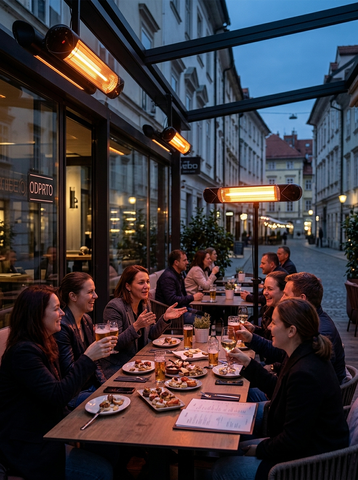
On an open terrace there is no point heating the air, because the wind carries it away immediately. What works outdoors is infrared heating: short-wave infrared radiation passes through the air with no significant loss and only warms what it lands on, which means the tables, the floor and the people. The sensation is the same as under autumn sun, when the air is cold but your face is warm. And because the heat is not carried by the air, it is felt immediately rather than ten minutes later.
Which type of heater for which terrace

With infrared heaters, how the unit is mounted is a more important decision than its wattage. The terrace is what determines which options are feasible at all.

  • On a wall or under a canopy. The most common solution, because it takes up no floor space. The IR heater VEBO 2500 W has four power steps and a remote control, which on a terrace with changing occupancy is more useful than it sounds; it covers up to 30 m² and is rated IP55. The wall-mounted Varma 2000 W is similar, and for canopies and pergolas there is the ceiling-mounted Tivoli 2000 W.
  • On a stand. For when there is no wall, or when the heaters have to be put away every day. The Porto 2000 W on a height-adjustable stand or on a telescopic stand heats the area wherever you need it that evening. The telescopic stand takes up to two heaters.
  • Under the table. The most overlooked option. The under-table Cobalt 1000 W and Imus 550 W warm the legs and lower body, which is exactly what gets cold first, and they take up no space on the terrace at all. The Cobalt switches itself off if tilted or knocked over.
  • Into the furniture. The heated bar table Mensa Statio 700 W has the heating element in the base and warms standing guests who move freely around it. The feet can be anchored to the floor, and the motion sensor switches the heater off three minutes after the last person leaves the table, which on a bar table with uneven occupancy is where the biggest saving sits. For tables at normal height there is the heated table Mensa 650 W.

A dedicated wall bracket is available for the VEBO heater.
Image
Image

When a gas heater makes sense

A gas heater works differently: it warms the air and radiates heat downwards under its reflector. It makes sense where the area is at least partly sheltered from wind and where there is no mains supply or not enough of one, and also where the heater is only out for a few days a year.

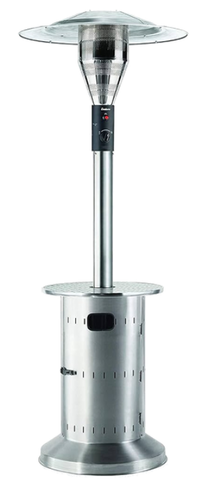
The range includes the gas patio heater Enders Commercial, intended for professional outdoor use. Output is infinitely adjustable from 4 to 14 kW, the cylinder sits in the base on a pull-out shelf, and the door locks and has a chain eye, which on a public terrace is not a trivial detail. The heater is certified to EN 14543 and carries an EU type-examination certificate under Regulation (EU) 2016/426.

There is one limitation worth knowing in advance: a gas heater may only be used outdoors or in a well-ventilated space where at least 25 % of the surrounding surfaces are open. If you close the terrace for winter with side panels or a marquee, a gas heater is no longer permitted in it and becomes dangerous. A closed or nearly closed terrace is therefore a case for an electric infrared heater, not a gas one.

For occasional use, renting is cheaper

If you need heaters for a handful of events, a wedding or a Christmas programme, buying often does not add up. In that case renting IR heaters with a stand or other items from the rental range is the more sensible route.

Heaters are only one part of the autumn terrace. On matching colours, materials and layout, see the article 5 ideas for a modern café or bar terrace.

Infrared or gas heater for a hospitality terrace?

On an open and windy terrace, infrared, because it warms people and objects directly and the heat is not carried off by the wind. A gas heater makes sense in partly sheltered spots where there is no adequate mains supply, or where the heater is only out for a few days a year. If the terrace is closed or nearly closed, only an electric infrared heater is an option.

How many watts do I need per table?

Rather than watts per table, the more useful question is where the heater will radiate from. A wall or ceiling heater of 2000 to 2500 W covers several tables, while an under-table heater of 550 to 1000 W warms a single table, but precisely where the guest notices the cold first. With uneven occupancy, power steps and a motion sensor pay off more than a higher rated output.

May I use a gas heater under a closed marquee?

No. A gas heater is only permitted outdoors or in a well-ventilated space where at least 25 % of the surrounding surfaces are open. For closed and covered terraces, use an electric infrared heater.

Need help choosing?

AG VEBO specialises in chairs, tables and other professional equipment for the HoReCa & Events sector. Tell us how the terrace is laid out, where you have a wall or a canopy and what electrical supply is available, and we will suggest the type of heater that is actually workable on that terrace.

 See the terrace heating range ·  Contact ·  Projects ·  Browse the catalogue

AG VEBO d.o.o.

Author: Boštjan Vesel, AG VEBO d.o.o.

References and sources

  1. EN 14543: LPG patio heaters for outdoor or amply ventilated area use.
  2. Regulation (EU) 2016/426 on appliances burning gaseous fuels, EUR-Lex.
  3. AG VEBO: Patio heaters, technical data for the individual models.
  4. AG VEBO: 5 ideas for a modern café or bar terrace, 2026.
Ask us