Cart

Adapting Your Terrace to the Season

Adapting Your Terrace to the Season

Adapting Your Terrace to the Season

Terrace Through the Seasons: A Month-by-Month Calendar When Should You Open and Close a Hospitality Terrace?

When the terrace season starts and when it ends is more often a matter of habit than of weather.

In April we carry the tables out; in October we put them away. Yet the average daily high in those two months is practically the same. In Slovenia, where AG VEBO is based, it is about 16 °C in both. (Source: ARSO, climatological normals 1981–2010. The same pattern holds across temperate Europe.)

The difference between April and October is not warmth, it is light. Across the EU the clocks go back on the last Sunday in October, after which the sun sets before 5 p.m. The evening part of the terrace is therefore not too cold, it is dark. That is actually good news, because darkness is solved with light and heat, not with new furniture.

What follows: what genuinely changes on a terrace through the year, what stays, and a calendar you can work from.

A terrace does not have only two seasons

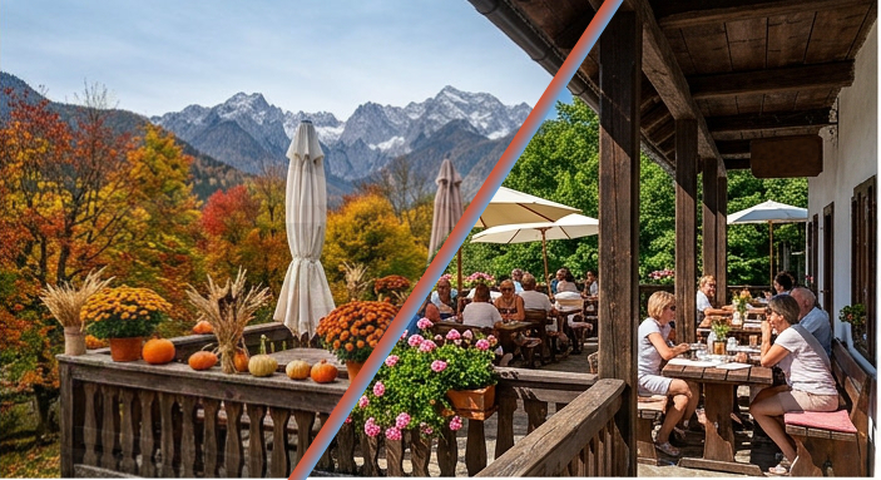
We usually think of a terrace as either open or closed. In reality it passes through four periods during the year, and each brings its own problem: one in spring, another in summer, another in autumn and another in winter.

Period Main constraint What removes it
Early spring (March–April) cold mornings and evenings, wind, low sun heaters, cushions, considered layout
Summer (June–August) sun and midday heat shade: parasols, planting
Autumn (September–November) darkness, rain, cold evenings lighting, heaters, textiles
Winter (December–February) frost, salt, damp, storage space correct storage or weather-resistant furniture

Each of these periods has a different constraint and therefore a different solution. A terrace furnished only for July will work less well in April and October than it could.
Image

The two layers of a terrace: what stays and what changes

The most useful distinction in seasonal planning is not between good-looking and practical, but between what stays all year and what changes.

Permanent layer Seasonal layer
What belongs to it chairs, tables, table bases, table tops seat cushions, parasols, heaters, planting, textiles, lighting
How often it changes every 8–10 years 2–4 times a year
What it determines the venue's character, comfort, capacity atmosphere and usability in a given period
Buying criterion durability and suitability for professional use quick replaceability and price

The point is simple: let the light layer carry the seasonal change, not the furniture. A terrace has to stay recognisable through the year. A guest who sat with you in July should recognise you in October.

This works with neutral and with coloured furniture

Both routes are legitimate; only the seasonal layer behaves differently.

  • A neutral base (black, anthracite, grey, white) gives the seasonal layer the most freedom. Light, airy cushions in summer; warmer, darker tones in autumn. You set the colour of the space afresh each time.
  • A coloured base is itself a recognisable mark of the venue, and that is exactly why it stays all year. The seasonal layer does not compete with it but supports it: you change intensity, texture and materials, not the colour scheme. Garden chairs in terracotta work well in summer with linen cushions in a natural tone, and in autumn with heavier, darker textiles.

So the mistake is not the colour of the furniture. The mistake is having nothing on the terrace that could be changed at all through the year, because then the terrace looks identical in April, July and October, even though a guest comes for three different things in those months.

We wrote more about coordinating colours and materials on a terrace in 5 Ideas for a Modern Café or Bar Terrace.
Spring: opening up and the post-winter check

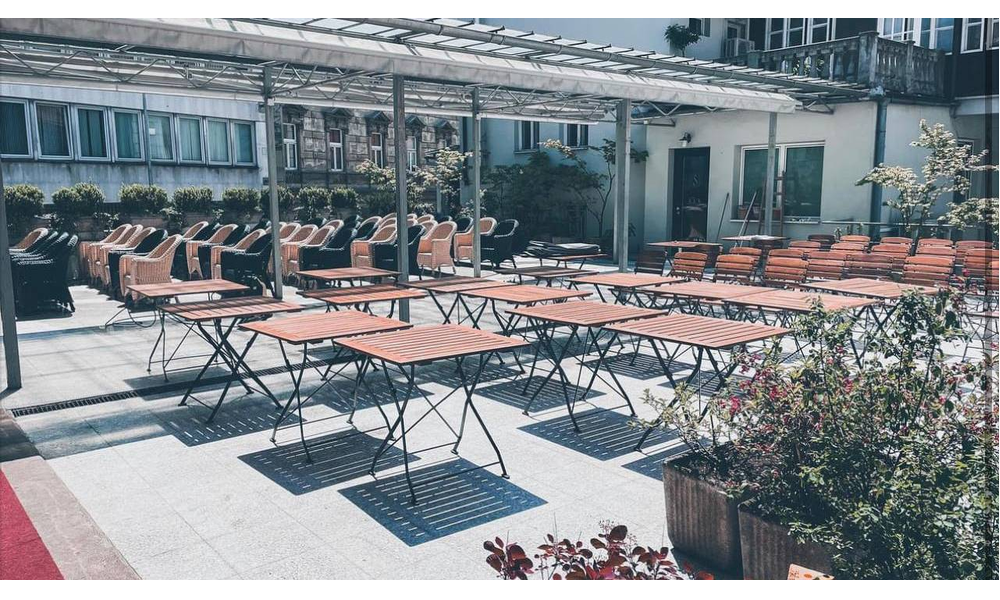
The first warm weekend in March or April arrives unannounced every year, and every year too soon. Venues that are ready then pick up the trade that the others lose.

The post-winter check

Before the furniture goes out, it is worth inspecting. Half an hour of checking saves a complaint in the middle of the season.

  • Floor glides on chairs and tables: a missing glide means scratched flooring and an unstable table.
  • Screws and joints: after a season of being moved, something always works loose.
  • Table stability: check the levelling, as the ground settles over winter.
  • The condition of the table bases, especially the bottom edge. If the terrace is next to a pavement that gets salted in winter, that is where the first damage appears. We covered this in detail in our article on hot-dip galvanizing of table bases.
  • Cushions and textiles: anything that stood damp over winter needs airing and inspecting.
  • Parasols: the mechanism, the fabric, the stability of the base.

What is different in spring from summer

In March and April the sun is low. A parasol that completely covers a table at midday in July does nothing at five in the afternoon in April, because the sun comes in from the side. In spring it is therefore often better not to open the parasols at all and to use the sun as an asset, since guests have only just come out of winter.

What does work in spring are terrace heaters and cushions. April evenings cool quickly, and a heater is the difference between a guest who orders one more drink and a guest who pays and leaves.

Summer: shade is capacity, not decoration

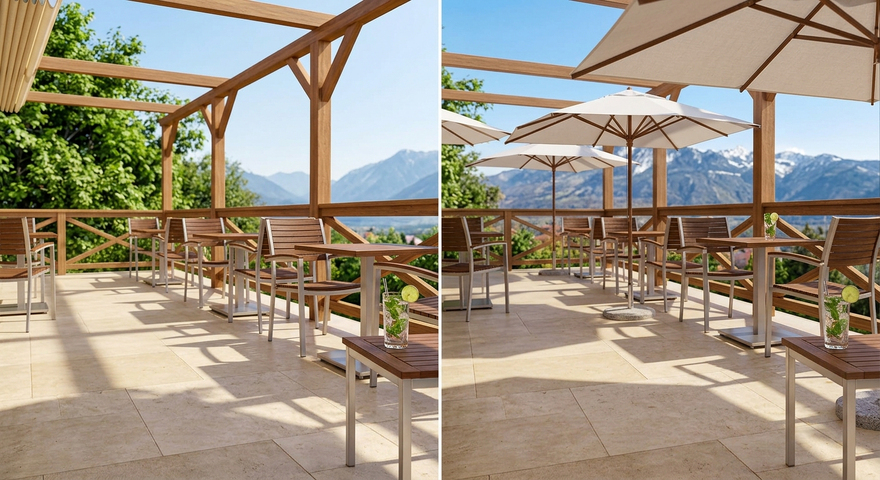
In July and August the constraint on a terrace is the sun. A table in full sun at 2 p.m. does not sell. It physically exists, but commercially it does not. This is the most underrated fact in terrace planning.

So it makes no sense to see parasols as decoration. See them as purchased seats. A parasol that covers four tables turns them from dead into active space for the whole summer.

Summer checklist

  • Check which tables are in shade at midday. Not from the floor plan, but by walking out at 1 p.m. and again at 4 p.m., because the shade moves during the day.
  • Lighter, paler textiles. Dark cushions heat up in the sun to the point of discomfort.
  • More frequent cleaning. Summer brings the highest footfall and the fastest table turnover, and the wear matches.
  • UV load. Summer is when the furniture takes the most. This is where it shows whether the materials really are intended for outdoor use. We wrote about the differences between materials in Aluminium or polypropylene for terrace furniture.
  • Planting. Plants do the most in summer: they shade, they lower the perceived temperature, and they separate the terrace from the street.

If you have a pool or a lawn beside the venue, summer is also the only period when it pays to put out sun loungers.
Image

Autumn: where the season actually gets longer

Back to the figure we started with: October daily highs are roughly the same as April's. October is nonetheless the month when terraces usually close.

There are three reasons, and none of them is temperature:

  1. Darkness. After the clocks go back at the end of October, the sun sets before 5 p.m. A terrace that is not lit simply does not exist after that hour.
  2. Evening cold. The daily maximum is April's; the evening minimum is not.
  3. Habit. We close the terrace because that is how it is done, not because the weather demands it.

The first two reasons are solved with equipment you largely already have.

A simple calculation of whether heaters pay off

Rather than general promises about returns, it is better to work with your own numbers. Take:

  • D = how many extra operating days you expect (for example two weeks early in spring and three weeks in autumn, so roughly 35 days)
  • T = how many tables you will actually use in that period (not all of them: realistically the ones against the wall, under the canopy, near the heaters)
  • R = how many table turns per day in that period (fewer in autumn than in summer)
  • M = average margin per table turn

Additional contribution = D × T × R × M, from which you subtract the energy the heaters use and the extra staff time.

An illustrative example (the figures are invented, insert your own): 35 days × 6 tables × 2 turns × €12 margin is roughly €5,000 of contribution per season. Whether that adds up depends entirely on your numbers. The purpose of the calculation is to make the decision on the basis of your actual trade rather than a feeling.

One more thing matters: you do not get those days by paying more rent, taking more floor area or hiring more staff. It is the same square metres you are already paying for.
Image

Autumn checklist

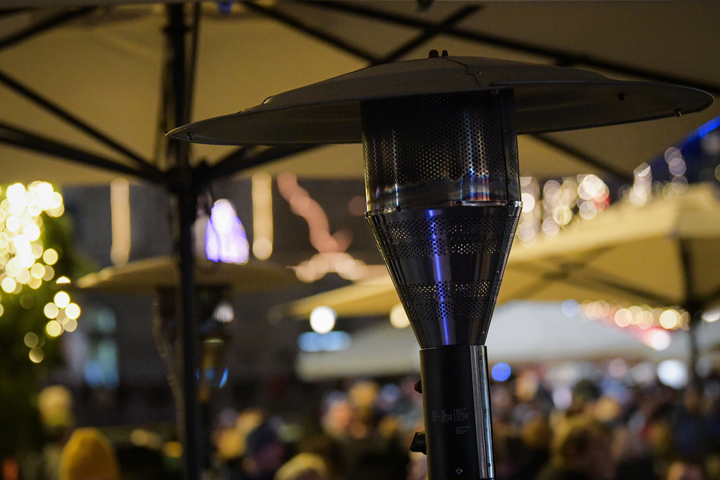
  • Lighting. The cheapest and most underrated measure. Warm, bright enough light makes the terrace usable in October.
  • Heaters. Put them where people actually sit longer, not spread evenly across the whole terrace.
  • Blankets and heavier textiles. A cheap measure with a disproportionate effect on how long a guest stays.
  • Shrink the terrace deliberately. In autumn it is better to have a smaller, full and warm terrace than a large, half-empty one. Put the surplus tables away, because an empty terrace tells a passer-by that the place is closed.
  • The parasols stay. In autumn they do not protect against sun but against drizzle and light rain.

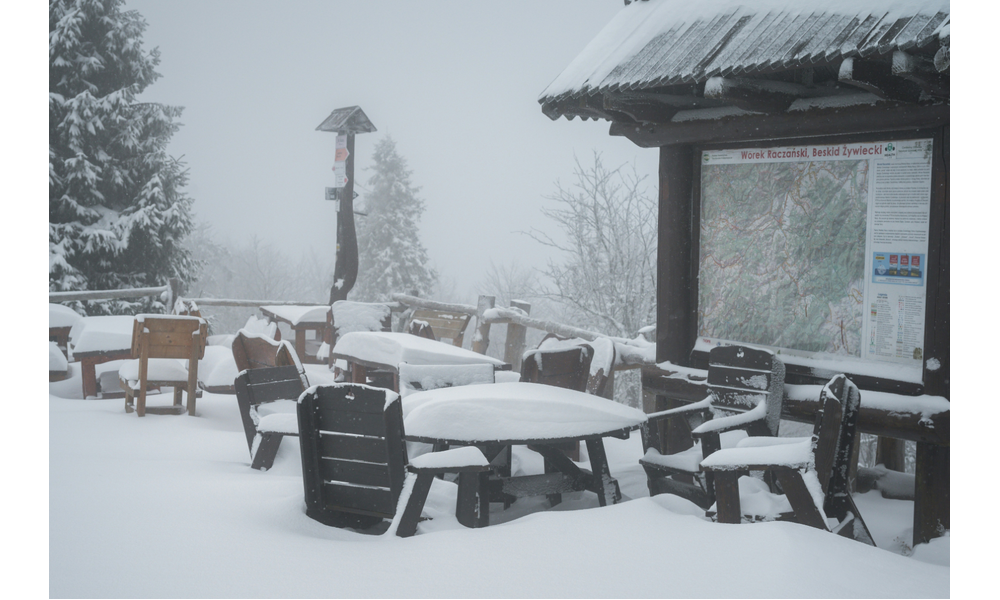
Winter: putting everything away without damage

Winter is when furniture is most often damaged, and not by the cold but by being stored wrongly.

What goes inside and what can stay out

  • Always inside: seat cushions, textiles, parasol canopies, blankets. Damp in folded textile means mould by spring.
  • As a rule inside: lighter chairs and tables, if you have the space. Folding tables and stacking chairs show their value here: a folded-down terrace takes up several times less room.
  • Can stay out: heavier table bases, if they are properly protected. What decides here is the corrosion protection, not the weight.

Three practical pointers

  1. Store the furniture dry. Wet chairs stacked on top of one another do not dry until spring, and by then they have done damage.
  2. Do not store directly on the floor in a damp room. A pallet or a riser costs little, while condensation under the bottom chair does the most harm.
  3. Move the furniture away from paths that get salted. Pavement salt is more aggressive towards table bases than frost is.

If you only furnish a terrace occasionally, for a handful of events, weddings or seasonal functions, then instead of year-round storage it is often better value to use chair and table rental. For frequent moving and for events there is also the ZOWN catering programme with transport trolleys.

Terrace calendar, month by month

A practical summary you can print and pin up in the office.

Month What to do
February Inspect the furniture in storage. Order the missing floor glides, cushions and spare parts, because lead times are shorter in February than in May.
March Clean the terrace, check the ground and the levelling. Set out a smaller part of the terrace, since the first warm weekend arrives unannounced. Heaters out.
April Full layout. Spring cushions. Parasols ready, though not necessarily open.
May Check the shade at different hours of the day. Adjust the table layout to the flow of trade.
June–August Summer mode: shade, lighter textiles, planting, more frequent cleaning. The heaters can be put away.
September Still full season. Prepare the lighting and check the heaters before you need them.
October Autumn mode: light, heaters, heavier textiles, blankets. Shrink and concentrate the terrace deliberately.
November The decision: close, or operate a smaller, heated terrace. Gradual packing away.
December–January Furniture stored and dry. If part of the terrace operates for a festive programme, make it the most sheltered part.


What to buy so that seasonal changes are even feasible

How well a terrace works seasonally is decided at the point of purchase, not at the first changeover. If you move the furniture up and down four times a year, properties other than the catalogue photograph start to matter.

  • Stackability and nesting. Ten stacked chairs instead of ten scattered ones is the difference between a store room and chaos.
  • Weight. Every kilogram is multiplied by the number of items and the number of moves per year.
  • Strength of construction. Furniture that goes up and down four times a year takes considerably more load than furniture that stands still. That is one more reason to choose furniture intended for professional use. More on this in Certificates for HoReCa furniture.
  • The option of seat cushions. If a chair will not take a cushion, you have closed off the cheapest seasonal measure there is.
  • Corrosion protection on the bases. Important above all if the furniture stays outdoors or if the terrace is beside a salted path.
  • Table top materials according to the actual exposure. An overview of the options is in the table tops category.

You can see some concrete examples of terraces furnished for year-round use among our projects.

FREQUENTLY ASKED QUESTIONS

When should a hospitality terrace open and when should it close?

According to climatological normals, the average daily high in April and October is roughly the same, about 16 °C in Slovenia and similar across temperate Europe. A terrace can therefore be open from March or April until the end of October, and on a reduced scale in November. The constraint in autumn is not temperature but darkness and rain, which are solved with lighting, heaters and textiles.

What should be changed on a terrace by season?

Change the light layer: seat cushions, textiles, planting, lighting, the positioning of parasols and the presence of heaters. Do not change the chairs, tables and bases by season; that is the permanent layer, and it gives the venue its recognisability throughout the year.

Do terrace heaters pay off?

It depends on your numbers. Calculate: the number of extra operating days × the number of tables you will actually use in that period × table turns per day × average margin per turn, minus the energy used and the extra staff time. The key advantage is that these are the same square metres you already pay for; the extra days bring no extra rent and no larger team.

Do parasols serve any purpose in autumn?

Yes, but with a different function. In summer they protect against the sun and create usable seats; in autumn they protect against drizzle and light rain. There is therefore no need to put them away at the same time as the summer layout.

How should terrace furniture be stored over winter?

Store it dry, never wet and stacked. Cushions, textiles and parasol canopies must always go into a dry indoor space. Do not place furniture directly on the floor in a damp room; use pallets or risers. Whatever stays outside should be moved away from paths that are salted in winter.

Is it better to have a smaller or a larger terrace in autumn?

In autumn it is generally better to shrink and concentrate the terrace deliberately. A smaller, full and heated terrace works better than a large, half-empty one, because empty tables tell a passer-by that the venue is closed or unvisited.

Do coloured chairs make seasonal adaptation harder?

No. Coloured furniture is often a recognisable mark of the venue and stays all year. In that case the seasonal layer does not fight it but supports it: you change the intensity, texture and materials of the cushions and textiles, not the whole colour scheme.

Planning a terrace for the whole year?

AG VEBO specialises in chairs, tables and other professional furniture for the HoReCa & Events sector. If you are furnishing a terrace from scratch or thinking about extending the season, tell us how the terrace operates and how much storage space you have. We take that into account in the selection too, not only the appearance.

 Contact us ·  Parasols ·  Terrace heaters ·  Browse the catalogue

AG VEBO d.o.o.

Author: Boštjan Vesel, AG VEBO d.o.o.

Ask us